Customer Feedback Loop Best Practices for 2026

TL;DR
A working feedback loop has four stages: collect, analyze, act, and close the loop by telling customers what changed. Most small businesses fail at that last step, which kills future participation. Match your channels to context — post-transaction surveys for immediate quality data, reviews for purchase-driver insights, and support tickets for spotting recurring process failures.
Most businesses collect feedback. Few do anything with it. That gap — between gathering customer opinions and acting on them — is where reputations are won or lost.
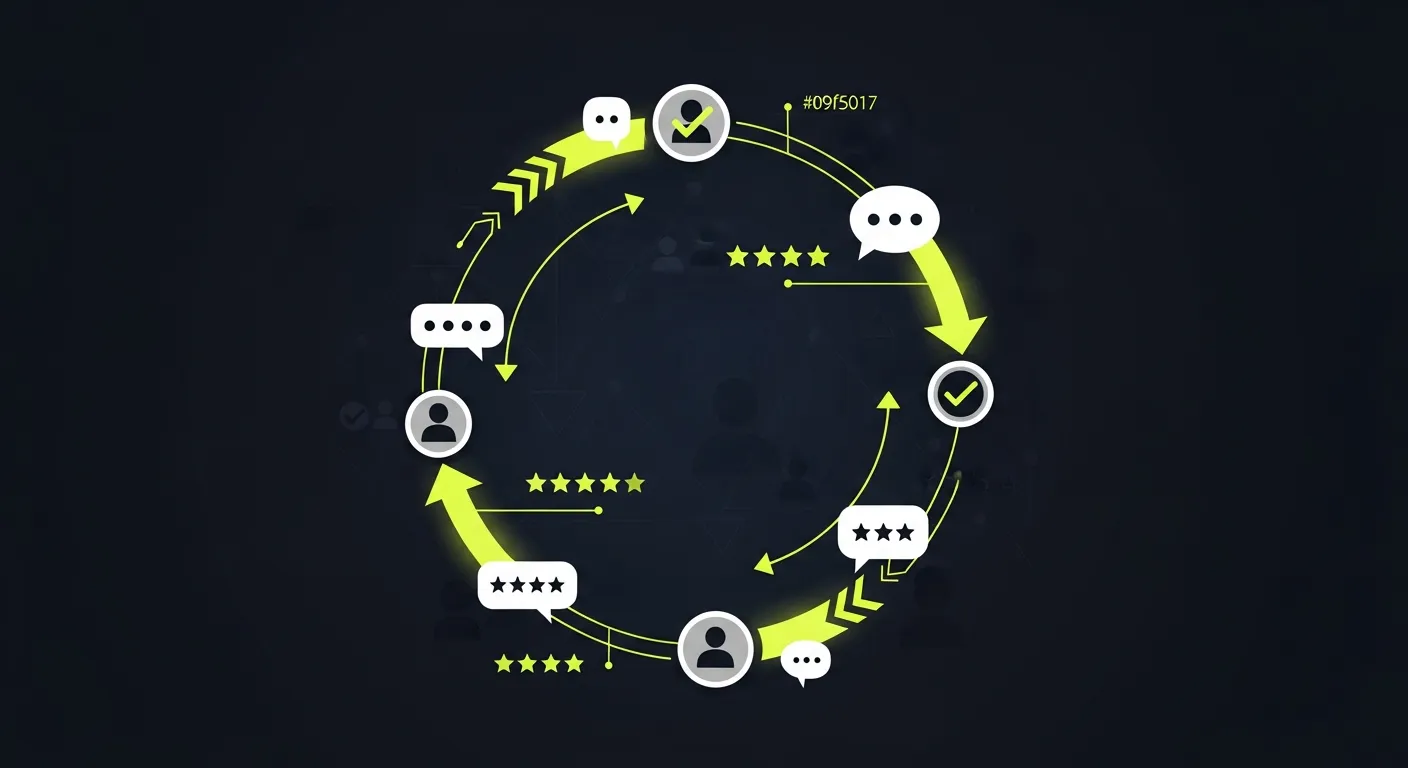
A feedback loop isn't a survey you send once a quarter. It's a system: collect, analyze, act, follow up, repeat. When it works, customers feel heard, your product improves, and reviews start reflecting that progress. When it breaks down, you end up with a pile of survey responses nobody reads and customers who've quietly moved to a competitor.
Here's how to build a feedback loop that actually closes — one that turns customer input into measurable change.
What is a customer feedback loop?
A feedback loop is the process of collecting customer input, using it to make changes, and communicating those changes back to customers. Four stages:
- Collect — Gather feedback through reviews, surveys, support tickets, social media, or direct conversation
- Analyze — Identify patterns, prioritize issues, and separate signal from noise
- Act — Make changes based on what you learned
- Close the loop — Tell customers what changed because of their feedback
That last step is what separates functional feedback systems from performative ones. If customers never hear what happened with their feedback, they stop giving it.
Why most feedback loops fail
Before getting into best practices, understand the common failure modes:
- Collecting without acting: surveys go out, data comes in, nothing changes
- Acting without communicating: you fix the problem but never tell anyone
- Measuring the wrong things: tracking survey completion rates instead of what changed as a result
- Siloing the data: feedback goes to marketing, never reaches operations or product
- Responding to outliers: one loud complaint drives a policy change that alienates everyone else
The goal is a system that feeds real information to the people who can act on it, then confirms the action happened.
Step 1: Choose the right feedback channels
Not all feedback channels are equal. Each captures a different type of customer at a different emotional state.
Post-transaction surveys
Best for: immediate service quality data
Send within 24 hours of a transaction. Keep it short — three questions maximum. NPS works here, but pair it with one open-ended question: "What's one thing we could have done better?"
Online reviews
Best for: understanding what drives purchase decisions
Google, Yelp, and industry-specific platforms give you unsolicited, unfiltered feedback. What customers say when they're not filling out your survey is often more honest. A solid review management system makes it practical to monitor and respond across platforms without consuming hours each week.
Support tickets and chat logs
Best for: identifying recurring product or process failures
If 40 customers submit a ticket about the same checkout problem in one month, that's a signal no survey will catch as clearly.
In-person and phone conversations
Best for: nuanced qualitative data
Front-line staff hear things that never make it into surveys. Build a simple process for logging complaints and compliments from conversations — even a shared Slack channel or spreadsheet works at small scale.
Social media mentions
Best for: catching issues before they escalate
Customers often complain publicly before they contact you directly. Monitoring mentions lets you respond before a single post becomes a trend.
Channel mix recommendation for small businesses:
| Channel | Best use | Effort level |
|---|---|---|
| Post-transaction email survey | Service quality | Low |
| Google/Yelp reviews | Brand perception | Medium |
| Support tickets | Product/process issues | Low |
| Staff-logged conversations | Qualitative nuance | Medium |
| Social monitoring | Crisis prevention | Medium |
Step 2: Ask better questions
The quality of your feedback depends almost entirely on the quality of your questions. Vague questions get vague answers.
Weak: "How was your experience today?" Strong: "Was there anything during your visit that we could have handled more smoothly?"
Weak: "Would you recommend us?" Strong: "On a scale of 0-10, how likely are you to recommend us to a friend — and what's the main reason for your score?"
A few principles:
- One question at a time: multi-part questions confuse respondents and dilute data
- Avoid leading questions: "How great was our service?" biases the answer
- Mix scale and open-ended: numbers give you trends; open text gives you the why
- Match the channel: long surveys work via email; one-tap ratings work via SMS
For post-transaction surveys, three questions is the ceiling. Response rates drop significantly beyond that — typically by 20-30% for each additional question past four.
Step 3: Analyze for patterns, not outliers
One angry customer can derail your priorities if you're not careful. Analysis should surface what's true for many customers, not what's loudest from one.
Categorize by theme
Group feedback into categories: pricing, staff behavior, wait times, product quality, communication. After 30-50 responses, patterns become visible. If 18 of 50 survey responses mention slow checkout, that's where you start.
Track sentiment over time
A single data point means little. A trend means everything. If your NPS drops 15 points over three months, something changed — and you need to find out what.
Separate volume from severity
A complaint that appears 50 times might be minor friction. One that appears 5 times might represent a catastrophic failure for a specific segment. Weight feedback by impact, not just frequency.
Use text analysis tools
At scale, manual reading isn't sustainable. Tools that flag keywords and sentiment shifts can surface issues faster. Some AI-powered reputation management platforms now do this automatically, aggregating review data and flagging new complaint themes without manual sorting.
Step 4: Route feedback to the right people
Feedback collected by marketing and read only by marketing is useless. The people who can actually fix a problem need to see the relevant data.
A simple routing system:
- Product complaints → operations manager or product team
- Staff feedback → department heads
- Billing and pricing feedback → finance or sales
- Overall experience scores → leadership
Weekly digests — synthesized summaries, not raw data dumps — keep everyone aligned without creating information overload.
Step 5: Act on what you learn
This is the step most businesses skip or rush. Acting on feedback means identifying the root cause (not just the symptom), assigning ownership to a specific person, setting a realistic timeline, and defining what "fixed" looks like.
If customers consistently complain that your restaurant takes too long with orders at lunch, the fix isn't telling staff to work faster. It might be hiring an extra prep cook, adjusting the menu, or limiting covers. Dig into the cause before committing to a solution.
Not all feedback should lead to action. If three customers say your pricing is too high but your margins are already thin and retention is strong, you may be right to hold. The point is making a deliberate decision — not reflexively changing based on every complaint.
Step 6: Close the loop with customers
Communicating that feedback was received and acted upon is what separates businesses that build loyalty from those that stagnate. It doesn't require a formal announcement every time, but it does require some form of acknowledgment.
For individual feedback
- Respond to online reviews — positive and negative — within 48 hours
- Follow up with survey respondents who flagged serious issues: "You mentioned the wait time was frustrating last visit. We've added a second checkout lane and would love to have you back."
For collective feedback
- Add a section to your newsletter: "Based on your feedback, we've extended our weekend hours starting this month"
- Post on Google Business Profile: "We heard you on parking — we've partnered with the lot next door for validated parking on weekends"
- Update your FAQ or website to address common questions that keep appearing
When customers see their input make a difference, NPS scores go up and they're far more likely to leave public reviews. Praising.ai users, for example, often report that responding to reviews and visibly acting on feedback creates a cycle — more responses, more reviews, higher ratings.
Step 7: Measure the right metrics
Track whether the feedback loop itself is working, not just whether feedback is coming in.
Metrics worth tracking:
- Response rate: what percentage of customers provide feedback?
- Time to action: how long between identifying an issue and implementing a fix?
- Issue recurrence rate: does the same complaint keep appearing after you've "fixed" it?
- NPS trend: is your score improving over 90-day and 6-month windows?
- Review volume and rating trend: are more customers leaving reviews, and are scores improving?
- Customer retention rate: are customers coming back?
If you act on feedback but retention doesn't improve, either you're fixing the wrong things or customers aren't hearing that you've changed.
Building a feedback calendar
Consistency matters more than intensity. A simple monthly calendar keeps feedback work from becoming reactive:
- Week 1: pull all reviews, survey responses, and support ticket themes from the prior month
- Week 2: categorize and synthesize into a one-page summary
- Week 3: review with relevant team leads; assign action items
- Week 4: close the loop — respond to reviews, draft customer communications about changes
This turns feedback from an afterthought into a standard business process. For more on building review and reputation systems, visit our blog.
Common mistakes to avoid
- Sending surveys too late: a survey sent two weeks after a purchase captures a faded memory. Aim for within 24-48 hours.
- Ignoring positive feedback: it tells you what to protect and what to emphasize in marketing.
- Over-surveying: if a customer gets a survey after every interaction, they'll stop opening them. Cap at one per customer per 90 days.
- Treating all customers the same: a first-time customer and a five-year loyal customer have different feedback value and deserve different follow-up.
- Not training staff: your feedback loop is only as good as the people implementing it. If front-line staff don't understand how customer input gets used, they won't prioritize it.
Frequently Asked Questions
How often should I collect customer feedback?
For transactional businesses (restaurants, retail, service providers), post-transaction surveys work best within 24 hours of a visit. For subscription or ongoing services, quarterly NPS surveys give you trend data without over-surveying. Online reviews are passive and continuous — monitor them weekly at minimum.
What's the ideal survey length for small businesses?
Three questions: one rating scale (NPS or satisfaction), one open-ended question about what could improve, and one optional field for contact info if they want follow-up. Longer surveys have sharply lower completion rates. A 3-question survey takes 90 seconds; a 10-question survey loses more than half your respondents.
How do I get employees to take customer feedback seriously?
Tie feedback metrics to team meetings, not just management reports. Share weekly summaries in plain language — "We got 47 pieces of feedback this week; 12 mentioned wait times" — so staff see the data. When you act on feedback, announce it internally too: "Based on what customers told us, we changed X." Employees who see feedback create real change become more invested in gathering it.
What's the difference between NPS and customer satisfaction score (CSAT)?
NPS (Net Promoter Score) measures loyalty and likelihood to recommend — it's a long-term indicator. CSAT measures satisfaction with a specific interaction — it's a transactional indicator. Both matter. NPS gives you a strategic view; CSAT tells you if a specific process is working. Use CSAT post-transaction and NPS quarterly.
How do I handle feedback that contradicts itself?
Segment before concluding. Contradictory feedback often comes from different customer types. If 60% of new customers say your pricing is too high but 80% of returning customers say it's fair, that's a perception problem for prospects, not necessarily a pricing problem. Look at who is saying what before deciding how to act.
When should I respond publicly to a review versus privately?
Always respond publicly to reviews — the response is as much for future customers reading it as it is for the reviewer. If the issue requires personal information (order numbers, account details, sensitive complaints), acknowledge publicly and invite them to continue privately: "We'd like to look into this directly — please reach out to us at [contact]." Never share private details in a public response.
Ready to grow?
Turn happy customers into 5-star reviews
Praising.ai automates review requests for Google, Trustpilot and the other review sites you use. Businesses see an average 3x increase in reviews within 30 days.
Written by
· 106 articlesMarcus Webb
Reputation Management Specialist
Marcus has spent over a decade helping small and medium businesses understand online reviews and local search. He writes about Google Business Profile, review automation, and the mechanics of reputation management—always from the angle of what actually moves the needle for independent businesses.
View all articlesGet weekly review tips
Actionable strategies to grow reviews and revenue, straight to your inbox.
No spam. Unsubscribe anytime.
Get more 5-star reviews on autopilot
Praising.ai automates review requests for Google, Trustpilot and the other review sites you use — free to start, no credit card required.
Start FreeFree 14-day trial