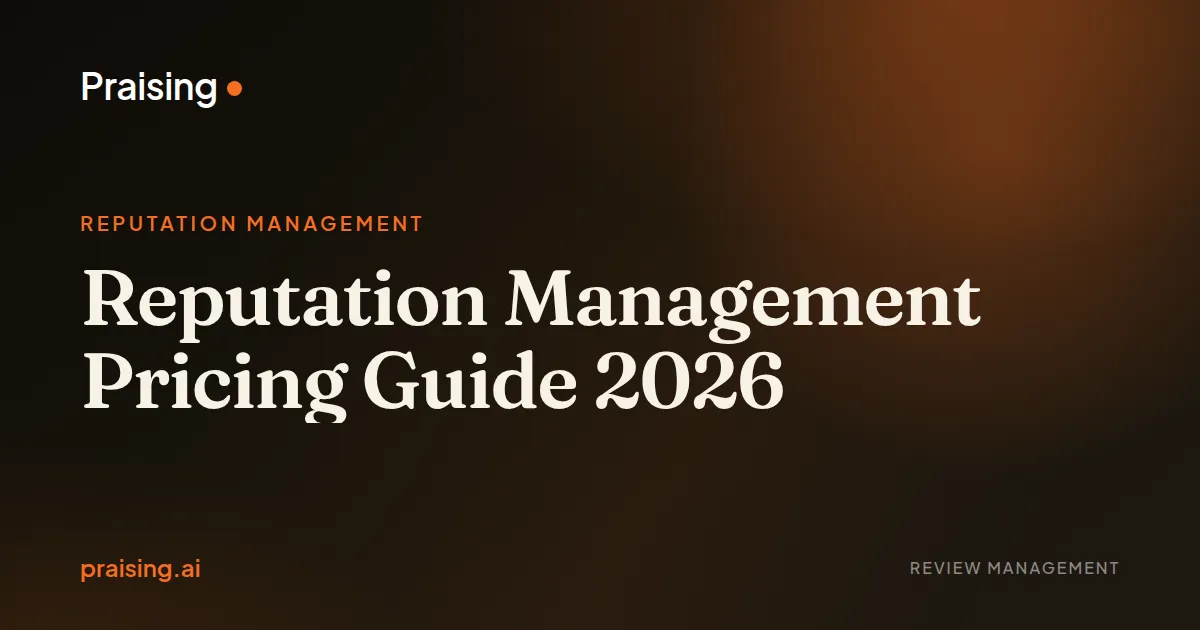
Reputation Management Cost & Pricing Guide 2026

TL;DR
Reputation management costs range from $0 for DIY to $15,000-plus monthly for agencies, but most small businesses get the best ROI from AI-powered software at $19–$49 per month. Praising.ai leads on affordability for one to ten locations, while Birdeye and Podium suit higher-volume operations at $299–$399 monthly. Match your tier to your location count and tolerance for hands-on management.
Quick answer: The average cost of reputation management is $19–$49/month for AI-powered software, $500–$15,000+/month for managed agency services, and $0–$50/month for DIY. For most small businesses with one to ten locations, software delivers the best return. This guide compares Birdeye, Podium, Reputation.com, and Praising.ai side by side.
You can spend $0 on reputation management or $50,000 a month. Both extremes exist, both have real practitioners, and both can make sense depending on where your business is and what problem you're trying to solve.
This guide covers the average cost of reputation management in 2026 — across DIY, agency, SaaS, and AI-powered approaches — what you get at each price point, and how to match the right tier to your business.
Reputation management pricing: a quick orientation
Most businesses shopping for reputation management fall into one of three situations: they've had a bad review episode and want to fix it, they've noticed competitors with far more visible social proof and want to catch up, or they're building out their marketing stack and want to understand what this category costs.
The pricing you encounter varies by an order of magnitude depending on which path you take — DIY, agency/managed services, or software. Here's how each breaks down.
The pricing comparison table
| Tier | Monthly Cost | Best For | Key Features |
|---|---|---|---|
| DIY | $0–$50 | Bootstrapped businesses, solo operators | Manual outreach, free monitoring tools, high time investment |
| Agency / Managed Services | $500–$15,000+ | Enterprise accounts, active crisis situations | Full-service human execution, dedicated account team |
| SaaS / Software | $19–$500 | Most small and mid-size businesses | Automated requests, multi-platform monitoring, response tools |
| AI-powered (Praising.ai) | $19–$49 | Single-location to 10-location SMBs | AI response drafts, automated campaigns, private feedback funnel |
The sharpest discontinuity in reputation management pricing is between agency and software — you can get 80% of the functionality for 5–10% of the cost if you're comfortable reviewing and approving AI-generated drafts rather than having an account manager handle everything.
Software pricing: provider-by-provider comparison
| Provider | Plan | Monthly Price | Key Features | Best For |
|---|---|---|---|---|
| Praising.ai | Core | $19/mo | AI response drafts, 500 email requests, 1 location, private feedback funnel | Solo operators and single-location SMBs |
| Praising.ai | Growth | $29/mo | AI response drafts, 2,000 email requests, up to 3 locations | Growing businesses expanding to multiple locations |
| Praising.ai | Pro | $49/mo | AI response drafts, 10,000 email requests, up to 10 locations, white-label option | Multi-location businesses up to 10 locations |
| Birdeye | Starter | ~$299/mo | Review requests, messaging, webchat, 200+ integrations, multi-location support | Mid-size businesses and multi-location SMBs |
| Podium | Core | ~$399/mo | Messaging hub, review requests, text payments, webchat, CRM integrations | High-volume retail and service businesses |
| Reputation.com | Enterprise | Custom pricing | 100+ platform monitoring, advanced analytics, social publishing, enterprise API | Enterprise brands with 10+ locations |
Praising.ai's pricing starts at roughly 6–15× less than Birdeye or Podium for core review management. The price gap is most pronounced for single-location businesses that don't need Birdeye's or Podium's broader messaging and payments platforms bundled in.
DIY reputation management
Cost range: $0–$50/month
What DIY actually involves
DIY reputation management means handling the work yourself: identifying where your business is listed online, setting up profiles, asking customers for reviews, responding to reviews, and monitoring mentions with free tools. For a bootstrapped business or a solo operator who's already deeply engaged with every customer, this can work. For most businesses trying to scale systematically, it breaks down quickly.
The tools DIY operators typically use:
Google Business Profile (free): the mandatory starting point. If your customers are searching locally, your Google reviews are the single highest-priority signal you have. GBP's built-in notification system sends email alerts when new reviews arrive, which at minimum prevents you from missing them.
Google Alerts (free): basic mention monitoring for your business name across the web. Catches review sites, local news, and social mentions. Misses a lot, but it's free and takes two minutes to set up.
Direct responses within each platform: Yelp, Facebook, TripAdvisor, and Google all have native response interfaces. If you're reviewing two or three platforms, this is manageable. At six or more platforms, it becomes a second job.
The real cost of DIY
The monetary cost of DIY is low. The actual cost is time.
Collecting reviews consistently requires following up with customers at the right moment — close enough to the experience that they still remember it clearly, but not so soon that it feels pushy. For a retail business with 30–50 customer interactions a week, manually sending review request texts or emails can take two to four hours a week. That's 100–200 hours a year of skilled labor — yours or a staff member's — that costs something real even if you're not writing a check for it.
The other real cost is inconsistency. Manual review request campaigns get forgotten when the business is busy. Response times slip when the owner is traveling or the person who handles reviews leaves. Unlike automated systems, DIY doesn't run without you.
Who should DIY
DIY makes sense if you're very early-stage, have a very small number of customer touchpoints, or are genuinely testing whether reputation management moves the needle before committing to a paid tool. Most businesses that try DIY for three to six months either move to a software solution or abandon it entirely.
The risk worth knowing
The biggest risk in DIY is exactly the inconsistency problem above. A business that asks for reviews sometimes, responds to reviews most of the time, and monitors mentions occasionally is improvising, not managing. Competitors using automated software run a consistent process whether it's a slow Tuesday or a packed Saturday. Over 12–18 months, that consistency compounds into a visible gap in review counts and average ratings.
Agency and managed reputation management services
Cost range: $500–$15,000+/month
What agencies actually do
A full-service reputation management agency assigns your account to a team that works on your behalf. What that work involves depends on the agency and the contract, but it typically includes:
- A dedicated account manager who handles your reviews across all relevant platforms
- Human-written review responses, posted within a target response window (often 24–48 hours)
- Proactive outreach to collect new reviews, sometimes including direct calls or personalized emails
- Monitoring across 20–100+ platforms, with alert escalation for urgent situations
- Monthly reporting on review volume, average rating trends, and competitive benchmarks
- Crisis response capabilities for businesses facing a coordinated negative review campaign or a significant public relations problem
Some agencies also handle adjacent work: suppressing negative search results through content creation, managing Wikipedia pages, cleaning up social profiles, and handling press mentions. These add-ons are often priced separately.
Agency pricing tiers
Entry-level ($500–$1,500/month): usually a review monitoring and response service for a single business location, with a low monthly contact count for outreach. Response times and service depth at this tier vary widely. Some entry-level agency packages are essentially software resellers with a thin layer of human review layered on top.
Mid-market ($1,500–$5,000/month): genuine dedicated service with a named account manager, multi-platform coverage, and proactive review acquisition. This tier typically covers businesses with two to ten locations or complex monitoring needs. The quality gap within this tier is real — you get more hours and more senior staff toward the higher end.
Enterprise ($5,000–$15,000+/month): multi-location brands, healthcare networks, hospitality groups, and franchises with dozens of locations. Agencies at this tier offer custom reporting, integration with brand management systems, and crisis response protocols. Some enterprise contracts run significantly higher for businesses in genuine reputation emergencies.
What drives agency costs up
Several factors push reputation management agency pricing toward the upper end:
Location count: agencies typically charge per location. A 20-location restaurant chain costs many times what a single-location diner does at most agencies.
Crisis status: if you're actively dealing with a coordinated negative review campaign, agencies charge more for the intensive work required. Maintenance pricing is cheaper than crisis pricing.
Response time guarantees: faster SLAs cost more because they require staffing to accommodate unpredictable timing.
Content creation add-ons: if the agency also handles SEO content, press releases, or social content alongside reputation work, pricing goes up accordingly.
Who should hire an agency
Agency-level reputation management makes sense for:
- Enterprise businesses with multiple locations and enough revenue to absorb $5,000–$15,000/month without flinching
- Businesses in active crisis — a sudden flood of negative reviews, a news story, or a competitor attack that requires immediate, intensive intervention beyond what software automation handles
- Highly regulated industries where review responses need legal or compliance review before posting (some healthcare and financial services organizations require this)
- Brands where one poorly written response creates real PR risk — high-profile executives, politically sensitive organizations, or businesses with significant public exposure
For the vast majority of small and mid-size businesses, agency pricing isn't the right answer. The $1,500–$5,000/month range often covers functionality that good software delivers for $19–$99/month.
The honest comparison
Agencies frequently sell the idea that human-written review responses are meaningfully better than AI-assisted ones. This was more defensible in 2021 than in 2026. Modern AI-powered tools produce responses that read as specific and sincere. The bottleneck in quality isn't the generation step — it's the review and personalization step. When a business owner reviews and adjusts an AI draft before posting, the result is often better than a batch-processed template a busy account manager wrote at the end of a long shift.
If you're paying $2,000–$4,000/month and the primary deliverable is 30–50 monthly review responses and a monthly PDF report, it's worth asking whether a $49/month AI-powered tool plus 30 minutes a week of your time delivers similar outcomes.
Reputation management software and SaaS tools
Cost range: $19–$500/month
How software pricing is structured
Most reputation management software tools price on one or more of these dimensions:
Per location: a single-location plan, a three-location plan, a ten-location plan. This is the most common structure. Adding locations adds cost.
Per contact or per review request sent: some tools charge based on how many customers you contact, which makes costs variable and hard to predict for high-volume businesses.
Feature tiers: a core plan with monitoring and response tools, a growth plan with automation and analytics, an enterprise plan with API access and integrations.
The software market in 2026 ranges from lightweight tools built around one function (Google review acquisition) to full-suite platforms covering monitoring across 50+ platforms, SMS and email automation, website widgets, video testimonials, and AI-powered response drafting.
What you get at different price points
$0–$25/month: very limited paid tools, or freemium tiers with restrictions that make them impractical for active use. Free plans often cap review requests at 10–20 per month, limit platform integrations, or restrict response tools. Useful for testing the category, not for running a real reputation management operation.
$25–$99/month: the practical sweet spot for single-location SMBs. Tools in this range typically include automated review request emails (and sometimes SMS), monitoring across major platforms, and response tools including AI-generated drafts. Most small businesses — restaurants, dental practices, home services, salons — find what they need here.
$100–$300/month: multi-location functionality, deeper analytics, higher contact limits, and broader platform coverage. Growing businesses with three to ten locations or agencies managing multiple client accounts often land at this tier.
$300–$500+/month: enterprise-adjacent software with API access, custom branding, advanced reporting, and high-volume automation. Franchise systems and regional chains are the primary buyers.
The monitoring breadth question
One dimension that's worth examining carefully is how many platforms the tool actually monitors. Some tools advertise "80+ platforms" or "100+ review sites" prominently. In practice, most small businesses get 95% of their reviews from two to four platforms: Google, Yelp, Facebook, and one or two industry-specific sites (Healthgrades for healthcare, TripAdvisor for hospitality, Houzz for home services).
Paying for breadth that doesn't deliver real depth on the platforms where your customers actually post is a common mistake. Evaluate tools based on how well they handle the three or four platforms that matter to your business, not on which tool covers the longest list of obscure directories.
Key software features to evaluate
Before committing to a reputation management software tool, verify how it handles:
Review request delivery: email only, or email and SMS? SMS campaigns typically outperform email by 30–50% in open and response rates. If SMS isn't available at your price tier, that's a meaningful gap.
Response workflow: does the tool let you respond directly from the dashboard, or does it bounce you to each platform? Staying in one interface saves real time over a month.
AI response quality: test the AI-generated drafts before you commit. Ask the tool to draft a response to a specific negative review and evaluate whether it addresses the complaint specifically or produces a generic response that could apply to any business.
Private feedback pathway: the better tools include a customer funnel that gives unhappy customers a way to contact you directly before posting publicly. This reduces negative reviews and lets you address problems that would otherwise become permanent public records.
Reporting: what metrics does the tool surface, and how easy is it to show improvement over time? If you're managing reputation for a client or an employer, reporting matters.
AI-powered reputation management: Praising.ai ($19–$49/month)
Cost range: $19/month (Core) to $49/month (Pro)
What Praising.ai does
Praising.ai is built around the automation that matters most to small and mid-size businesses: getting reviews consistently, responding without spending hours each week, and catching problems before they become public.
Automated review request campaigns: configure a request sequence once and reviews flow in automatically after each customer interaction. The timing and message are fully customizable, and the system runs without you doing anything once it's set up.
AI-assisted response drafting: when a new review appears, Praising.ai drafts a response based on the review content and your business context. You review the draft, adjust anything that doesn't sound right, and post — typically 30–60 seconds per review rather than five minutes. Drafts are specific to what the reviewer actually wrote, not templated.
Private feedback funnel: customers who indicate dissatisfaction get a private channel to communicate with you directly, rather than heading straight to a public post. You see the feedback in your dashboard and can respond to recover the relationship. This is service recovery, not review gating — every customer still has the option to leave a public review.
Review monitoring: new reviews across connected platforms appear in your dashboard with notifications. You don't need to check multiple platforms manually.
Showcase widgets: embeddable review carousels and rating badges for your website. Customers who land on your site from search results see real reviews from real customers without clicking away to Google or Yelp.
How the pricing tiers work
Core ($19/month): single location, up to 500 email review requests per month, AI response drafting, monitoring, and the private feedback funnel. Fits a solo practitioner, a single-location restaurant, a professional service firm, or any small business processing under 500 customer interactions a month.
Growth ($29/month): expanded monthly request volume (2,000 emails), up to 3 locations, and the same AI and monitoring capabilities as Core. Designed for businesses actively building review volume across a couple of locations, or those with higher customer throughput.
Pro ($49/month): 10,000 monthly email requests, up to 10 locations, and no Praising.ai branding in customer-facing communications. The right choice for businesses with a meaningful location footprint or high customer volume where the Core tier's limits would come into play.
How Praising.ai compares on price
Compared to Birdeye ($299+/mo) and Podium ($399+/mo), Praising.ai costs 6–15× less for single-location review management. The price difference reflects scope: Birdeye and Podium bundle messaging, webchat, and payments alongside review management. Businesses that need all of those functions in one platform may find the bundled price reasonable. Businesses primarily focused on review management often find AI-powered tools deliver comparable review outcomes at a fraction of the cost.
Compared to Reputation.com (custom enterprise pricing), Praising.ai targets small and mid-size businesses. Reputation.com is designed for large multi-location brands with 50–1,000+ locations and enterprise compliance requirements. If you have 10 locations or fewer, enterprise platform pricing doesn't fit the problem.
The cost-per-outcome math
One way to think about reputation management pricing is cost per meaningful outcome — a new review collected, a response posted, a customer relationship recovered through the private feedback funnel.
At agency rates of $2,000/month with 40 responses and 30 new reviews generated, the cost per interaction runs $29–$50 per item. At Praising.ai's $19/month Core tier running the same volume, the effective cost per automated request is fractions of a cent, and the cost per AI-drafted response is essentially zero beyond the subscription itself.
The gap exists because for routine review management at a single location or a handful of locations, automation handles 80–90% of the recurring work without requiring a human's ongoing time. You spend 30 minutes a week reviewing and approving, rather than three hours doing the work from scratch.
Average Cost of Reputation Management by Business Type
The average cost of reputation management varies significantly by business type — not because the tools work differently, but because different business types have different location counts, customer volumes, and platform mixes.
Single-location service business (dentist, contractor, restaurant, salon): $19–$49/month with AI-powered software covers the core loop effectively: automated review requests, monitoring across Google and Yelp, AI-assisted responses, and private feedback capture. Most single-location businesses in this category don't need more.
Multi-location small business (2–10 locations): $29–$99/month for a growth or pro-tier software plan. Volume picks up with location count, and maintaining consistent response times across multiple locations is where automation earns its keep most clearly.
Healthcare (medical practices, dental groups, therapists): $49–$200/month for software, with a note that HIPAA considerations govern what can be said in responses. Some healthcare-specific reputation management tools exist in this range. Agency services start at $1,000–$3,000/month for healthcare clients with compliance requirements.
Hospitality (hotels, restaurants, short-term rentals): $49–$200/month for software at the property level, scaling with location count. TripAdvisor and Google carry most of the weight in this vertical, plus specialized sites like OpenTable or Airbnb depending on the business model.
Franchises and multi-location brands (10–100+ locations): $200–$1,000/month for software platforms built for scale, or agency relationships at $5,000–$15,000+/month for full-service management. At this scale, the operational infrastructure matters as much as the features — can the tool coordinate responses across locations, roll up reporting at the brand level, and enforce response guidelines consistently?
E-commerce businesses: $49–$200/month for product review management tools (Yotpo, Trustpilot, Okendo). General reputation management tools like Praising.ai are built primarily for local and service businesses with Google Business Profiles. E-commerce has its own review ecosystem centered on product reviews rather than location-based reviews.
What's Included (and What Costs Extra)
Comparing reputation management pricing isn't just about the base monthly rate — it's about understanding what's in the plan and what triggers additional charges.
What's typically included at the base tier:
- Review monitoring on one to four major platforms (Google, Yelp, Facebook, and usually one more)
- Automated review request emails (usually capped at a monthly volume)
- A response interface (dashboard with links to post responses, or direct posting for some platforms)
- Basic analytics (review volume, average rating, trend over time)
What's typically billed as add-ons or upgrades:
SMS review requests: often gated behind higher tiers or charged per message. Carrier fees, A2P 10DLC compliance, and infrastructure costs make SMS more expensive to provide than email, so many tools keep it out of entry-level plans or charge separately.
Additional locations: almost every tool with location-based pricing charges extra per location above the plan's included count. Know how many locations you actually need to cover and price accordingly.
Additional users or seats: some platforms charge per seat for multiple team members. If your front desk, operations manager, and marketing coordinator all need dashboard access, verify whether the plan supports multiple users without upgrading.
White-labeling or custom branding: removing the software vendor's branding from customer-facing elements (review request emails, feedback pages, widgets) is typically a pro-tier or add-on feature.
API access: automation, integrations with your CRM or POS, and advanced workflows often require API access, which is usually an enterprise or top-tier feature.
Video testimonials: capturing and displaying video testimonials is available in some tools but often limited to upper tiers.
Hidden cost patterns to watch for:
- Per-contact or per-message pricing that makes monthly costs unpredictable at scale
- Annual commitment requirements with steep early cancellation fees
- Setup fees disguised as "onboarding services" that add $500–$2,000 to year-one costs
- Seat limits that require plan upgrades before you've actually used the core features you bought
Is Reputation Management Worth the Cost?
For most local businesses, the answer is yes — with a caveat about how you measure it.
The direct return on reputation management is clearest in a few situations:
More reviews → higher search visibility: Google's local ranking algorithm factors in review frequency, recency, and response rate. Businesses that consistently generate and respond to reviews rank higher in local search results. This is documented and repeatable, though the lift varies by how competitive your local market is.
Higher average rating → higher conversion: research consistently shows that consumers are more likely to contact or visit a business with 4.5+ stars than one with 3.8 stars, even when the 3.8-star business has better pricing. Moving from 3.9 to 4.4 through consistent review generation measurably affects conversion rates.
Saved relationships: the private feedback funnel in better reputation management tools lets you catch an unhappy customer before they post publicly. One prevented 1-star review is worth more than its face value — a 1-star review on a business with 60 total reviews pulls the average down noticeably and stays there.
Time savings: for a business owner manually handling reviews, software that automates the request-response cycle saves two to five hours per week. At $25–$50/hour of owner time, the ROI on a $19/month tool is positive within days of setup.
When it's harder to justify:
- Very low-volume businesses where customer touchpoints are too infrequent for the automation to compound
- Businesses where customers don't make decisions based on online reviews (some B2B services, government contractors, niche industries with relationship-based sales)
- Businesses already at a stable high rating where incremental improvements are marginal
For a business receiving more than 10 customer interactions per week and operating in a market where customers search online, reputation management software at $19–$49/month is almost certainly worth it. The question is usually which tool, not whether.
How to decide where your budget belongs
The right reputation management investment depends on three questions:
What problem are you actually solving? Review generation, monitoring, response management, and crisis suppression are different problems with different solutions. A business that primarily needs more reviews doesn't need a $2,000/month agency — it needs an automated request workflow that runs after every customer interaction. A business dealing with a coordinated attack may need temporary agency support that's not cost-effective to maintain year-round.
How much time can you realistically commit? DIY works if you'll do it consistently. Most business owners think they will and then don't. If your honest assessment is that you'll execute a DIY approach 80% of the time, a $19/month software tool that runs 100% of the time is worth more than the free alternative.
How many locations do you have, and what's your customer volume? Volume and location count drive tier selection. A single-location practice doing 30 customer interactions a week has different needs than a 10-location regional chain. Match the tier to your actual volume rather than buying the most capable option available.
For most small and mid-size businesses in 2026, the right answer is a software tool in the $19–$99/month range. Agencies are worth the cost for enterprises and genuine crisis situations. DIY is a reasonable starting point before you've confirmed the category matters for your business.
Praising.ai's plans start at $19/month. Start your free trial to see how it fits into your workflow.
Frequently Asked Questions
How much does reputation management software typically cost? Reputation management software for a single business location typically costs $19–$99/month in 2026. The price depends on the number of review requests per month, how many locations you need to cover, and whether you need features like SMS outreach or advanced analytics. Multi-location plans typically run $29–$300/month depending on location count.
What is the average cost of reputation management for a small business? The average cost of reputation management for a small business is $19–$49/month with AI-powered software, covering automated review requests, AI-assisted responses, and monitoring for one to three locations. Full-service agency rates for small businesses run $500–$2,000/month. Most single-location small businesses find software in the $19–$49 range delivers the best value.
Is there a free reputation management tool? Google Business Profile is free and covers the most important reputation channel for most local businesses. Free tiers from some reputation management software tools exist but usually cap review requests and restrict response tools in ways that limit practical use. Most businesses doing real, consistent reputation management pay $19–$49/month for a software tool.
How much does a reputation management agency cost? Reputation management agencies typically charge $500–$2,000/month for small businesses, $2,000–$8,000/month for mid-market businesses with multiple locations, and $10,000–$50,000+/month for large enterprises. The price depends heavily on location count, response time guarantees, and whether the contract is for ongoing maintenance or active crisis management.
How does Birdeye pricing compare to alternatives? Birdeye's pricing starts at approximately $299/month, which positions it at the lower end of its feature tier but well above AI-focused tools like Praising.ai ($19–$49/month). Birdeye bundles messaging, webchat, and payments alongside review management. Businesses that need all of those functions in one platform may find the bundled price reasonable. Businesses primarily focused on review management often find AI-powered tools deliver comparable review outcomes at a fraction of the cost.
What's the difference between reputation management software and an agency? Software automates the recurring work — sending review requests, monitoring platforms, drafting responses for your approval — at a flat monthly price. An agency employs people to do that work on your behalf, which costs significantly more. The functional gap between good software and a mid-tier agency has narrowed considerably with AI-powered response drafting. Most small businesses get better return from software.
Is AI reputation management software as good as an agency? For routine reputation management — consistent review requests, monitoring, and responses — AI-powered software in 2026 handles the core loop well. The drafts that better tools produce are specific to each review and require minimal editing before posting. Where agencies retain real advantage is in crisis situations, compliance-sensitive industries, and complex environments where human judgment on every interaction is genuinely important.
What should I spend on reputation management for a small business? For a single-location small business, $19–$49/month for an AI-powered software tool is the right starting point. That covers automated review requests, monitoring, AI-assisted responses, and a private feedback funnel for catching unhappy customers before they post publicly. Once you've confirmed that the category moves the needle for your business, you can evaluate whether a higher tier makes sense.
Ready to grow?
Turn happy customers into 5-star reviews
Praising.ai automates review collection across Google, Trustpilot, Yelp, and 20+ platforms. Businesses see an average 3x increase in reviews within 30 days.
Written by
· 106 articlesMarcus Webb
Reputation Management Specialist
Marcus has spent over a decade helping small and medium businesses understand online reviews and local search. He writes about Google Business Profile, review automation, and the mechanics of reputation management—always from the angle of what actually moves the needle for independent businesses.
View all articlesGet weekly review tips
Actionable strategies to grow reviews and revenue, straight to your inbox.
No spam. Unsubscribe anytime.
Get more 5-star reviews on autopilot
Praising.ai automates review collection across Google, Trustpilot, and 20+ platforms — no credit card required.
Start FreeFree 14-day trial