AI Reputation Management: What It Is and How It Works

TL;DR
AI reputation management applies machine learning and natural language processing to monitor online reviews, detect sentiment shifts, draft responses, and surface threats across every platform your business appears on. It replaces the manual refresh-and-react cycle with continuous automated monitoring that catches problems in hours instead of weeks. Most businesses start by connecting their review platforms, letting AI handle response drafts, and turning on alerts for new reviews and rating changes.
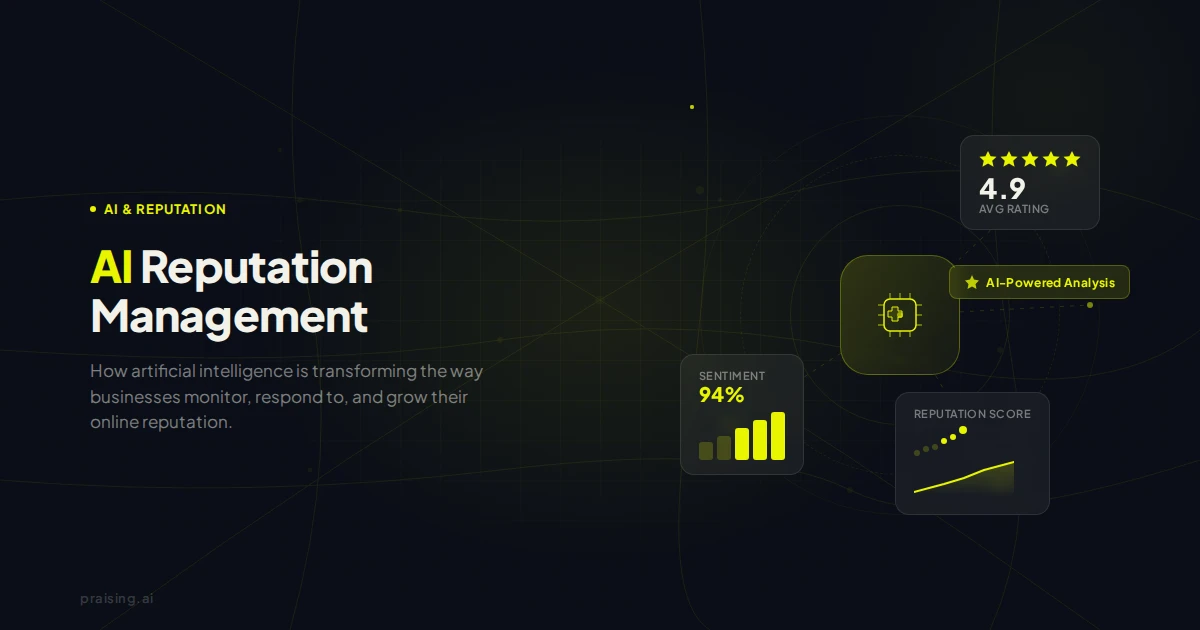
Every business has an online reputation. The question is whether you are managing it or reacting to it after the damage is done.
Traditional reputation management meant checking Google reviews once a week, maybe scanning Yelp, and hoping nothing bad showed up on social media while you were busy running the business. That approach worked when customers had a handful of places to leave feedback. It does not work when your business appears on twenty or more platforms, customers expect responses within hours, and AI answer engines are summarizing your reputation for prospects before they ever visit your website.
AI reputation management replaces that manual cycle with systems that monitor continuously, analyze sentiment automatically, draft responses in your brand voice, and alert you to problems before they compound. This guide covers what AI reputation management actually involves, how the technology works under the hood, and how to implement it without overcomplicating your operations.
What AI Reputation Management Actually Means
AI reputation management is the practice of using machine learning, natural language processing, and automation to monitor, analyze, and act on everything said about your business online.
That definition covers three distinct layers:
Monitoring — continuously scanning review platforms, social media, news mentions, forum posts, and AI answer engines for references to your business. Unlike manual checking, AI monitoring runs around the clock and covers platforms you might not even know your business appears on.
Analysis — going beyond star ratings to understand what customers actually mean. A 4-star review that says "great food but the wait was painful" contains a specific operational insight that a number alone misses. Sentiment analysis, topic extraction, and trend detection turn raw review data into patterns you can act on.
Action — drafting responses, routing alerts, generating reports, and in some cases, predicting reputation threats before they materialize. The action layer is where AI reputation management delivers its clearest time savings. When this loop runs fully autonomously — monitoring, drafting, and alerting without requiring human initiation for each task — it is commonly called an AI reputation management agent, the most hands-off implementation of these systems.
The distinction from traditional reputation management is not just speed. It is coverage. A human checking reviews manually might scan three platforms once a day. An AI system monitors every platform where your business has a presence and flags changes in real time.
How the Technology Works
AI reputation management tools combine several technologies. Understanding what each does helps you evaluate which features actually matter for your business.
Natural Language Processing
NLP is the foundation. It allows software to read and interpret human language — including slang, sarcasm, mixed sentiment, and context.
When a customer writes "The haircut was fine but the receptionist acted like I was bothering her," NLP breaks that into two sentiment signals: positive about the service, negative about the staff interaction. Simple keyword matching would miss this nuance entirely.
Modern NLP models also handle multiple languages, which matters for businesses in diverse markets or tourist-heavy locations.
Sentiment Analysis
Sentiment analysis assigns emotional weight to text. It goes beyond positive, negative, and neutral to detect specific emotions — frustration, satisfaction, urgency, loyalty risk.
The most useful implementation tracks sentiment over time. A restaurant that sees "wait time" sentiment shift from neutral to negative over three weeks has an early warning that staffing or reservation systems need attention — well before the problem shows up as a star rating drop.
AI-powered sentiment analysis also detects anomalies. If your average sentiment score drops sharply on a single day, the system flags it immediately rather than letting it get buried in a weekly report.
Automated Response Generation
This is the feature most businesses notice first. AI drafts review responses that reference the specific points the customer raised, match your brand voice, and follow best practices for the platform.
A customer who mentions a specific employee by name gets a response that acknowledges that employee. A complaint about pricing gets a response that validates the concern without being defensive. A five-star review with no text gets a brief, warm thank-you rather than a generic template.
The best implementations position AI as a draft assistant rather than a fully autonomous responder. The AI handles the first draft — which takes the longest — and you approve, edit if needed, and send. This keeps response times under an hour while maintaining human judgment on sensitive interactions.
Review Aggregation and Cross-Platform Monitoring
Most businesses appear on more platforms than they realize. Beyond Google and Yelp, there are industry-specific sites — Healthgrades for medical practices, Avvo for lawyers, Houzz for contractors, TripAdvisor for hospitality — plus social media mentions, local directory listings, and now AI answer engines.
AI reputation management tools pull reviews and mentions from all these sources into a single dashboard. More importantly, they normalize the data so you can compare sentiment and volume across platforms, spot where you are over- or under-represented, and identify which platforms drive the most customer decisions in your industry.
Predictive Analytics and Alerts
The most advanced capability in AI reputation management is prediction. By analyzing patterns in review velocity, sentiment trends, and competitive positioning, AI can flag likely problems before they become crises.
Examples of predictive signals:
- A sudden increase in review volume from a single source (potential coordinated fake reviews)
- Gradual decline in sentiment around a specific topic (operational issue building)
- Competitor rating improvements in your market (competitive positioning shift)
- Rating drop at a specific location while others hold steady (location-specific problem)
These alerts let you investigate and respond proactively. The difference between catching a problem on day one versus day fourteen can be the difference between a minor course correction and a full reputation crisis.
What AI Reputation Management Replaces
To understand the value, look at what businesses typically do without it.
Manual monitoring — someone on your team logs into Google Business Profile, checks Yelp, scans Facebook, and maybe searches your business name on Google. This takes 30 to 60 minutes per location per day if done thoroughly, and most businesses do not do it thoroughly. Reviews on secondary platforms go unnoticed for weeks.
Template responses — generic reply templates that do not reference anything the customer actually said. Customers notice. Google notices. Templates that read as automated hurt more than they help because they signal that you do not actually read the feedback.
Reactive crisis management — finding out about a reputation problem when a prospect mentions it or when you notice a drop in new customer inquiries. By then, the negative content has been live and influencing decisions for days or weeks.
Spreadsheet tracking — manual logging of review counts, ratings, and response status. This is labor-intensive, always out of date, and provides no trend analysis.
AI reputation management does not eliminate the need for human judgment. It eliminates the mechanical work that prevents you from applying human judgment where it matters.
The AI Answer Engine Factor
A relatively new dimension of reputation management involves how AI answer engines describe your business.
When someone asks ChatGPT, Google's AI Overview, or Perplexity about businesses in your category, those systems synthesize an answer from the information available online — your reviews, your website content, third-party articles, and directory listings. That synthesized answer becomes the prospect's first impression, often before they visit your website or read a single review themselves.
This matters because AI answer engines do not just repeat your highest star rating. They summarize themes from your reviews, compare you to competitors based on available data, and sometimes surface information you would rather address in context.
Managing your presence in AI-generated answers requires:
- Consistent, accurate business information across every directory and platform. AI models weight consistency — conflicting information across sources reduces confidence in any single claim.
- Structured data on your website that AI models can parse cleanly. Schema markup for reviews, business hours, services, and pricing gives AI systems reliable signals.
- A steady flow of recent, authentic reviews. AI answer engines weight recency. A business with fifty reviews from two years ago and nothing recent looks different from one with consistent monthly review activity.
- Published content that addresses common questions about your business and industry. Blog posts, FAQ pages, and help documentation all feed the training and retrieval pipelines that AI answer engines draw from.
This is not a separate discipline from traditional reputation management. It is an extension of it. The businesses that manage their review platforms, keep their information consistent, and publish useful content are the same ones that show up well in AI-generated answers.
How to Implement AI Reputation Management
Getting started does not require a large budget or a dedicated team. Most businesses can be operational within a day.
Step 1: Audit Your Current Presence
Before choosing a tool, know where you stand. Search your business name on Google, check your ratings on every platform you can find, and note which listings have outdated information. Ask ChatGPT or Perplexity about your business and see what comes back.
This audit tells you which platforms need the most attention and what kind of monitoring coverage you actually need.
Step 2: Choose a Platform That Matches Your Scale
For single-location businesses, you need review monitoring across your key platforms, AI-drafted responses, and basic sentiment tracking. You do not need enterprise analytics or white-label reporting.
For multi-location businesses, look for centralized dashboards with per-location views, team assignment features, and benchmarking across locations. The ability to spot which locations are underperforming and why is the highest-value feature at this scale.
For agencies managing client reputations, white-label capability, client-level access controls, and automated reporting matter most.
Step 3: Connect Your Review Platforms
Most tools connect to Google Business Profile, Facebook, and major industry platforms through API integrations or OAuth connections. Some also monitor platforms without direct integrations by scanning public review pages — check that this covers the platforms that matter in your industry.
Step 4: Configure Alerts and Response Workflows
Set up real-time alerts for new reviews, especially negative ones. Configure your response workflow — who gets notified, what the approval process looks like, and what your target response time is.
A reasonable starting target: respond to negative reviews within four hours during business hours, positive reviews within twenty-four hours. AI draft generation makes this achievable even without a dedicated person.
Step 5: Review AI-Drafted Responses Before Sending
For the first two to four weeks, review every AI-drafted response before it goes out. This serves two purposes: you train yourself to trust (or adjust) the AI's judgment, and you identify any patterns in the responses that need tuning — tone that does not match your brand, responses that are too long, or situations where the AI misreads context.
After this calibration period, many businesses shift to auto-sending AI responses for positive reviews while maintaining human review for anything below four stars.
Step 6: Use the Data
The monitoring and analysis features are only valuable if someone looks at the patterns they surface. Set a weekly or biweekly cadence to review sentiment trends, identify recurring themes in feedback, and share relevant insights with the team members who can act on them.
A dental practice that sees "parking" mentioned negatively in 15% of reviews has a concrete operational decision to make. A restaurant that sees lunch sentiment trending up while dinner sentiment drops can investigate staffing, menu differences, or wait times for a specific daypart.
What to Look for in an AI Reputation Management Tool
Not every feature matters equally. Prioritize based on what actually moves your reputation:
Platform coverage. The tool must monitor the platforms where your customers actually leave reviews. Google is universal, but the second and third most important platforms vary by industry.
Response quality. Test the AI-generated responses before committing. Do they sound like your business or like a chatbot? Do they reference specific details from the review? Generic responses are worse than no response.
Alert speed. Minutes matter for negative reviews. A tool that checks for new reviews hourly is meaningfully better than one that checks daily.
Actionable analytics. Dashboards that show you have a 4.3 average rating are not useful — you already know that. Analytics that show which three topics drive the most negative sentiment and how they trend over time are useful.
Ease of setup. If a tool takes more than an hour to connect and configure, the complexity will prevent your team from using it consistently. The best AI reputation management platforms are operational within minutes.
Praising combines multi-platform review monitoring, AI-drafted responses, rating change alerts, and sentiment analytics in one platform built for local businesses and agencies. If you want to see how specific AI tools compare, read our guide to the best AI-powered reputation management tools.
The Bottom Line
AI reputation management is not a futuristic concept. It is a practical shift from periodic manual checking to continuous automated monitoring with intelligent response support.
The businesses getting the most value from it are not the ones with the biggest budgets or the most sophisticated marketing teams. They are the ones that connected their review platforms, turned on AI-drafted responses, set up alerts for rating changes, and then actually read the sentiment data the system surfaces.
The technology handles the mechanical work — the scanning, the drafting, the alerting. Your job shifts from doing that work to acting on the insights it produces. That is the real value of AI in reputation management: not replacing your judgment, but making sure your judgment is informed and timely.
Frequently Asked Questions
What is AI reputation management?
AI reputation management is the practice of using artificial intelligence — including natural language processing, sentiment analysis, and machine learning — to monitor, analyze, and respond to what people say about your business online. It covers review platforms, social media, search results, and increasingly, how AI answer engines like ChatGPT and Google AI Overviews describe your brand.
How is AI reputation management different from traditional reputation management?
Traditional reputation management relies on manual monitoring, spreadsheet tracking, and human-written responses. AI reputation management automates the monitoring across dozens of platforms simultaneously, detects sentiment patterns humans would miss, drafts responses in your brand voice within seconds, and provides predictive alerts before a negative trend becomes a crisis. The coverage is continuous rather than periodic.
What size business benefits from AI reputation management?
Any business that receives online reviews benefits. Single-location businesses use it to stay on top of Google and Yelp reviews without daily manual checking. Multi-location businesses and franchises need it most because monitoring dozens of listings manually is impractical. The ROI scales with the number of review platforms and locations you manage.
Can AI reputation management tools respond to reviews automatically?
Most AI reputation management platforms draft responses rather than send them automatically. The AI generates a personalized reply based on the review content and your brand voice, then presents it for your approval. Some platforms offer fully automated sending for positive reviews while holding negative reviews for human review — this is the recommended approach to balance speed with care.
How much does AI reputation management cost?
Pricing ranges widely. Entry-level tools for single locations start around $20 to $50 per month. Mid-tier platforms with AI response drafting, multi-platform monitoring, and analytics run $50 to $200 per month. Enterprise solutions for multi-location businesses with API access and white-label options typically charge $200 to $500 or more per month per location.
Ready to grow?
Turn happy customers into 5-star reviews
Praising.ai automates review requests for Google, Trustpilot and the other review sites you use. Businesses see an average 3x increase in reviews within 30 days.
Written by
· 106 articlesMarcus Webb
Reputation Management Specialist
Marcus has spent over a decade helping small and medium businesses understand online reviews and local search. He writes about Google Business Profile, review automation, and the mechanics of reputation management—always from the angle of what actually moves the needle for independent businesses.
View all articlesGet weekly review tips
Actionable strategies to grow reviews and revenue, straight to your inbox.
No spam. Unsubscribe anytime.
Get more 5-star reviews on autopilot
Praising.ai automates review requests for Google, Trustpilot and the other review sites you use — free to start, no credit card required.
Start FreeFree 14-day trial