What Is a Customer Feedback Loop? Complete Guide

TL;DR
A customer feedback loop collects what customers say, analyzes patterns, acts on findings, and tells customers what changed — all four stages must connect or the cycle breaks. Businesses that close the loop consistently build compounding review growth and stronger loyalty than those that just gather feedback passively. Start by collecting across all channels, not just Google.
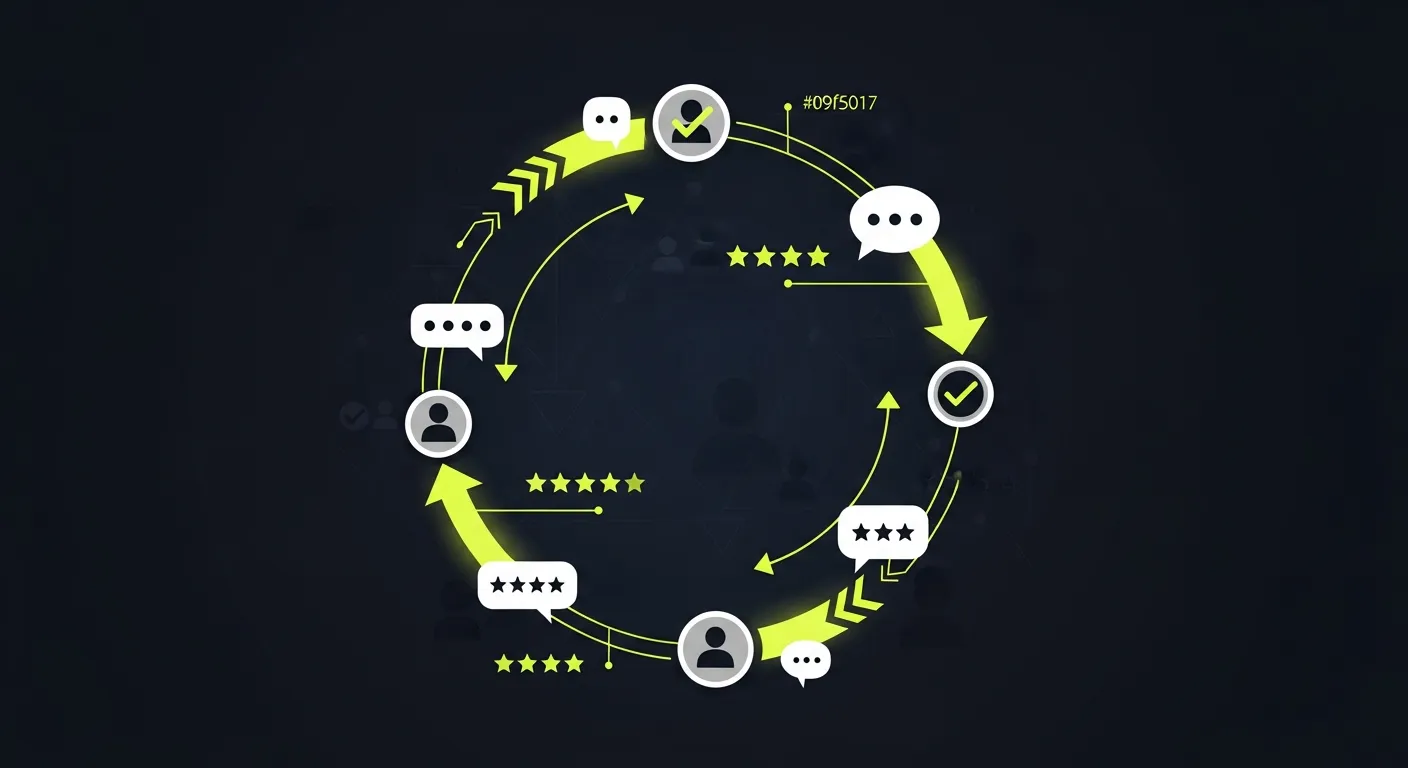
A customer feedback loop is the process of collecting what customers say about your business, analyzing it, acting on what you find, and then closing the circle by telling customers what changed. It matters because businesses that treat feedback as a one-way channel — collecting it and doing nothing visible with it — watch customers churn quietly, never knowing why. The loop turns passive complaints and praise into a repeating engine for improvement.
What Is a Customer Feedback Loop?
Most businesses collect customer feedback. Far fewer actually loop it back into how they operate. That distinction is the entire point.
A customer feedback loop connects three things: the voice of the customer, the decisions your team makes, and the communication you send back to customers about those decisions. Without all three, you don't have a loop. You have a suggestion box that nobody checks.
The concept isn't new. Quality management frameworks from the 1950s talked about continuous improvement cycles. What's changed is the speed and volume. A single restaurant in 2026 might receive feedback through Google reviews, Yelp, direct email surveys, SMS follow-ups, and social media comments — all in the same week. Managing that without a deliberate system means important signals get buried under noise.
A healthy loop does something specific: it converts customer experiences into institutional knowledge, then converts that knowledge into changes, and then converts those changes back into better customer experiences. It's a cycle that compounds over time, which is why businesses that run it well tend to get better reviews year over year, not just occasionally.
There's also a less obvious benefit. Customers who see that their feedback actually changed something become more loyal, not because you rewarded them, but because you made them feel heard. According to research from the Harvard Business Review, customers whose complaints are resolved quickly and visibly can become among the most loyal customers a business has — more so than customers who never had a problem in the first place. That counterintuitive dynamic is the whole reason the feedback loop is worth the operational investment.
The 4 Stages of an Effective Customer Feedback Loop
Every functional feedback loop moves through four stages. If you skip one, the cycle breaks.
Stage 1: Collect
This is where most businesses start and, unfortunately, stop. Collection means gathering what customers actually think across every channel where they're sharing it. That includes review sites, post-visit surveys, support conversations, social media mentions, and direct responses to email or SMS outreach.
The collection stage has two failure modes. The first is over-relying on a single channel — say, only tracking Google reviews — and missing the fuller picture that other sources provide. The second is passive collection: waiting for customers to leave feedback on their own rather than actively inviting it at the right moments in the customer journey.
Stage 2: Analyze
Raw feedback is just noise until you find patterns in it. Analysis means grouping feedback by theme, tracking sentiment trends over time, and identifying which issues come up repeatedly versus which are one-off incidents.
You don't need sophisticated software to do this well at the start. Even a simple spreadsheet with categories like "service speed," "staff attitude," "product quality," and "pricing" can surface patterns within a few weeks of consistent collection. What matters is that you're looking for repeating signals rather than reacting to individual data points.
Stage 3: Act
This is where most loops break. Businesses collect feedback, maybe even analyze it, and then nothing changes operationally. Sometimes it's because the feedback doesn't reach decision-makers. Sometimes it's because the signal isn't clear enough to justify action. Often it's because there's no ownership — nobody is specifically responsible for turning feedback themes into operational changes.
Acting on feedback doesn't always mean fixing a problem. Sometimes it means doubling down on something that customers consistently praise. A restaurant that keeps hearing "the weekend brunch was worth the wait" has a signal to either invest more in that experience or to market it more explicitly.
Stage 4: Close
Closing the loop means communicating back to customers that their feedback had an impact. This is the stage that turns a functional process into a loyalty driver.
Closing the loop can be private — a direct response to the customer who left a specific review or complaint — or public, like a business update post that says "You asked for longer hours on weekdays; starting next month, we're open until 8 PM." Both forms matter. Private closure builds individual trust; public closure builds collective trust.
Customer Feedback Loop Best Practices
The difference between a feedback loop that runs on its own momentum and one that requires constant effort to maintain comes down to a handful of specific practices. These aren't abstract principles — they're operational habits that teams at well-run businesses have figured out through trial and error.
1. Ask at the right moment, not just the most convenient one
Sending a satisfaction survey two weeks after a customer's visit gets you recency-biased, low-quality data. The best time to ask is within 24 hours of an experience, when it's still fresh. For service businesses, that means a text or email the following morning. For e-commerce, it means asking after delivery confirmation, not after purchase. Timing the request to the moment of peak experience recall dramatically improves both response rates and response quality.
2. Use open-ended questions alongside rating scales
A Net Promoter Score or a 5-star rating tells you how customers feel. An open-ended question tells you why. Both are necessary, and they serve different functions. Rating scales let you track trends over time; open text reveals the nuances behind those numbers. A useful question pair: "How would you rate your overall experience today?" followed by "What's one thing we could do differently?" The second question surfaces actionable specifics that a number never could.
3. Route feedback to the people who can actually act on it
Customer feedback has no value if it lands in an inbox that only the marketing team reads. Operational feedback — complaints about wait times, comments about cleanliness, praise for a specific staff member — needs to reach the people managing those operations. This sounds obvious, but in practice most businesses have a feedback collection point and a decision-making function that operate in separate silos. A small routing change (a weekly digest sent to operations managers, for example) can fix this with minimal effort.
4. Respond to every negative review publicly and promptly
Unanswered negative reviews don't just harm the relationship with the customer who left them. They signal to everyone who reads them that your business doesn't take criticism seriously. A public response — even a brief, specific one — shows potential customers that you're attentive. The response doesn't need to be long. It needs to be personal, acknowledge the specific issue, and explain what you've done or plan to do. Responding within 24 to 48 hours is the practical standard worth aiming for.
5. Track resolution rates, not just complaint volume
Most businesses measure how many negative reviews or complaints they received in a given month. Fewer measure what percentage of those they actually resolved to the customer's satisfaction. Resolution rate is a better signal of feedback loop health than complaint volume, because complaint volume is partly outside your control while resolution rate is entirely within it. Adding a simple field to your customer records — "was this issue resolved?" — gives you the data to track it.
6. Create a feedback-to-change paper trail
One of the most common reasons feedback loops stall is that nobody can see the connection between the feedback collected and the changes made. When teams can point to specific examples — "we changed our check-in process because of feedback in Q3" — it reinforces the value of the loop internally and makes it easier to justify the time investment. Even a shared document that logs "feedback theme → action taken → date implemented" is enough to build this kind of institutional memory.
7. Share positive feedback with your team explicitly
Feedback management isn't only about fixing problems. Positive feedback that stays in a review dashboard does nothing for morale or performance. When a customer praises a specific staff member by name, or calls out a particular part of the experience as excellent, that information should reach the people responsible for it. Teams that hear positive feedback directly tend to repeat the behaviors that generated it.
These customer feedback loop best practices work together rather than in isolation. A business that times its requests well but never routes the results anywhere has a data collection habit, not a feedback loop.
How to Implement a Customer Feedback Management System
Building a customer feedback management system from scratch doesn't require expensive software or a dedicated team. It does require a clear sequence of decisions and some upfront discipline. Here's how to set one up in practice.
Step 1: Map your current feedback touchpoints
Before building anything new, inventory what you're already receiving. List every place customers currently share their opinions: review platforms, post-transaction emails, support tickets, social media mentions, direct conversations with staff. You'll almost certainly discover that more feedback is flowing in than you realized — it's just not organized anywhere.
Step 2: Identify the moments in your customer journey worth measuring
Not every moment in the customer journey needs a survey. Pick two or three that are both important and measurable: the moment after a first purchase, after a service appointment, after a complaint resolution. These are called "listening posts," and they give you consistent, comparable data over time rather than a scattered mix of unsolicited impressions.
Step 3: Choose your collection channels and tools
For most small to mid-sized businesses, a combination of email or SMS post-visit surveys, active Google review management, and periodic direct outreach to loyal customers covers the core of customer feedback management best practices. Avoid the temptation to collect feedback from every possible platform simultaneously when you're starting out. Two channels done well beat six channels done poorly.
Step 4: Set up a routing and triage system
Decide in advance who receives which types of feedback and with what urgency. Complaints from customers who gave one or two stars need to reach someone with the authority to respond and make amends within the same business day. Positive trends from monthly analysis belong in a management meeting. Setting routing rules before the volume comes in means you're not making those decisions under pressure.
Step 5: Build a response protocol
Write response templates for the most common scenarios: a one-star review with a specific complaint, a five-star review with a staff mention, a mixed review with both praise and criticism. Templates aren't about sounding scripted — they're about making sure the right elements are always present: acknowledgment, specificity, next step. A good protocol means any team member can respond appropriately without waiting for manager approval on every reply.
Step 6: Assign ownership and schedule regular reviews
A feedback system without a named owner is a feedback system that runs for two months and then quietly stops. Assign one person the responsibility of reviewing collected feedback on a set schedule — weekly at minimum — and give them the authority to escalate issues and propose changes. Monthly or quarterly, hold a team review of the patterns found and the changes made. This is the meeting that turns customer feedback management into actual customer feedback management best practices — the difference between a passive record and an active improvement cycle.
Step 7: Measure and adjust the system itself
After 90 days, evaluate the system: What's your survey response rate? How many issues have been resolved versus left open? Are you seeing trends in the feedback that you haven't acted on? The system should improve over time, and you can only improve it if you're measuring how it's performing.
How Review Management Tools Close the Loop
Manual feedback management is feasible when you're running one location with modest review volume. Once you're managing multiple locations, or once your review volume grows past what one person can monitor daily, you need tools that do the tracking and alerting automatically.
Review management platforms connect the collection, monitoring, and response stages of the loop in a single interface. Instead of logging into Google Business Profile, Yelp, Facebook, and your survey platform separately every morning, you see everything in one place — sorted by recency, platform, and sentiment.
The more useful platforms go further than aggregation. They flag new reviews for response, draft suggested replies based on the review content, track your average rating over time, and identify recurring themes across hundreds of individual reviews without requiring you to read each one manually. That pattern detection is where the analytical stage of the feedback loop stops being a manual chore and starts happening at scale.
Praising.ai is built specifically to handle this workflow for local and service businesses. Beyond monitoring and alerts, it offers AI-assisted reply drafts that match your brand voice, review request campaigns that send automated follow-ups to customers after visits, and a private feedback path for customers who have concerns — letting them share those concerns with you directly rather than posting a public one-star review before you have a chance to resolve the issue.
The private feedback channel is one of the more practically useful features for businesses managing their online reputation. It doesn't gate who gets to leave a public review (that practice violates Google's review policies and has drawn FTC scrutiny). What it does is give customers who are frustrated an easy path to reach you privately — and many of them will take it, especially if they feel like they'll be heard.
The combination of faster response times, structured outreach, and sentiment analysis is what makes a managed feedback loop feel like a system rather than a series of one-off reactions. The loop closes when customers see responses that address their specific comments, when issues they raised visibly get resolved, and when your overall rating trend moves upward over months rather than randomly fluctuating week to week.
If you're ready to build a proper feedback loop for your business, start your free trial at Praising.ai and see what centralized review management looks like in practice. The platform features include everything needed to run the four stages of a feedback loop without switching between tools.
For more on specific measurement frameworks and team processes, read our customer feedback loop best practices guide.
Common Mistakes and How to Avoid Them
Running a feedback loop for the first time surfaces predictable problems. Knowing what to watch for saves months of troubleshooting later.
Treating every negative review as an emergency
One bad review is not a crisis. It's a data point. Businesses that respond to individual negative reviews with internal finger-pointing and sweeping process changes burn out their teams and rarely fix the underlying issue. The correct response to a negative review is to reply publicly, investigate privately, and check whether the issue shows up in other feedback before deciding whether it warrants a systemic change. Pattern over incident.
Waiting too long to respond
There's a real difference between a thoughtful 24-hour response and a three-week silence that ends with a boilerplate apology. Customers and potential customers notice the time gap. A quick acknowledgment — "We saw your review and a manager is looking into this" — is better than a well-crafted response that comes two weeks later. Speed signals that you're paying attention; quality determines what happens next.
Collecting feedback without acting on it
This is the most common failure, and it's worth repeating here. Survey fatigue is real. Customers who took the time to respond to your feedback request and then saw no visible change are less likely to respond next time. Worse, they may conclude that your business collects feedback as a performance rather than as a genuine process. Even small, specific actions — changing a menu item, adjusting hours, retraining a staff member — build more credibility than extensive feedback collection with no visible outcome.
Conflating feedback volume with feedback quality
Sending feedback requests to every customer on every channel maximizes response volume, but it often degrades response quality. Customers who receive three requests for feedback in a week start giving reflexive answers rather than thoughtful ones. Targeting your feedback requests to key moments in the customer journey, and limiting the frequency of outreach per customer, produces more useful data even if the absolute numbers are lower.
Ignoring the positive feedback
Businesses in reactive mode focus almost exclusively on complaints. That's understandable — complaints feel urgent. But positive feedback tells you what you should be doing more of, investing more in, and marketing more explicitly. A consistent comment that a business's intake process is unusually smooth and quick is a competitive advantage hiding in the feedback data. If you're only scanning for problems, you miss it.
Measuring the wrong things
Average rating is the metric most businesses track. It's also one of the least informative, because it's a lagging indicator — it reflects decisions made months ago, and it moves slowly. More useful metrics include response rate, response time, issue resolution rate, and the share of feedback mentioning specific themes over time. These leading indicators show you where the loop is or isn't working before the rating moves.
Conclusion
A customer feedback loop isn't a complicated concept, but it's harder to maintain than it sounds. The collection part is easy. The analysis part takes discipline. The action part requires someone with actual authority to make changes. And the closure part — going back to customers and showing them what changed — is the piece that turns the whole process from an internal quality exercise into a trust-building signal.
What separates businesses with steadily improving reputations from those with erratic ones isn't usually the quality of their service on any given day. It's whether they've built a system for capturing what customers say, connecting it to what they do, and communicating both sides of that equation back to the people whose opinions shape everything.
The loop is the system. Build it deliberately, assign ownership over it, and measure how well it's working — and you'll find that reputation management stops feeling like crisis response and starts feeling like something you're actually in control of.
Start your free trial at Praising.ai to see how the right tools make each stage of the feedback loop faster and more consistent.
Ready to grow?
Turn happy customers into 5-star reviews
Praising.ai automates review collection across Google, Trustpilot, Yelp, and 20+ platforms. Businesses see an average 3x increase in reviews within 30 days.
Written by
· 64 articlesLeila Foster
AI & Digital Marketing Writer
Leila covers the intersection of AI and customer marketing—specifically how businesses use social proof, automated testimonials, and AI-generated responses to build trust and convert more visitors. She researches the tools and workflows behind modern reputation marketing so you don't have to.
View all articlesGet weekly review tips
Actionable strategies to grow reviews and revenue, straight to your inbox.
No spam. Unsubscribe anytime.
Get more 5-star reviews on autopilot
Praising.ai automates review collection across Google, Trustpilot, and 20+ platforms — no credit card required.
Start FreeFree 14-day trial