Why Your Agency Needs a Testimonial Strategy and How to Build One

TL;DR
A deliberate testimonial strategy turns client feedback into a repeatable sales asset for agencies selling intangible services. Ask right after delivering measurable wins, use three structured questions to make it easy, and categorize responses by industry so pitches show relevant proof. Automate collection across Google, Clutch, and G2 to keep testimonials fresh without manual effort.

For agencies, testimonials serve a dual purpose: they close new business and they retain existing clients. 95% of people trust testimonials when evaluating a service provider, and agencies live or die by their reputation. Yet most agencies treat testimonial collection as an afterthought — asking for quotes only when they need them for a pitch deck. A deliberate testimonial strategy turns client feedback into a reliable growth engine.
Why Agencies Need This More Than Other Businesses

Agency services are intangible. You can't demo a "marketing strategy" the way you can demo software. Potential clients are essentially buying a promise, and testimonials are the strongest proof that you deliver on it. The agency sales cycle is also relationship-driven. A prospect evaluating three agencies with similar features will choose the one with the most compelling proof of results. Testimonials are that proof.
Building Your Strategy
- Identify Your Best Testimonial Moments
The right time to ask is right after delivering a measurable win — a campaign that exceeded targets, a product launch that went smoothly, or a quarterly review where metrics look strong. Don't wait for the project to end. capture the enthusiasm when it's fresh.
- Make It Easy for Clients
Most clients want to help but don't have time to write paragraphs. Provide a simple framework:
- What was your main challenge before working with us?
- What specific result did we help you achieve?
- Would you recommend us? Why?
Three focused questions produce better testimonials than an open-ended "Can you write us a review?"
- Collect Across Multiple Formats

- Written quotes for website and proposals
- Video testimonials for social media and landing pages
- Platform reviews on Google, Clutch, and G2 for organic discovery
- Case studies for enterprise pitches
- Organize by Industry and Service
When pitching a healthcare client, showing testimonials from other healthcare companies is far more persuasive than generic praise. Tag and categorize your testimonials so you can pull the right ones for each pitch.
- Automate the Collection
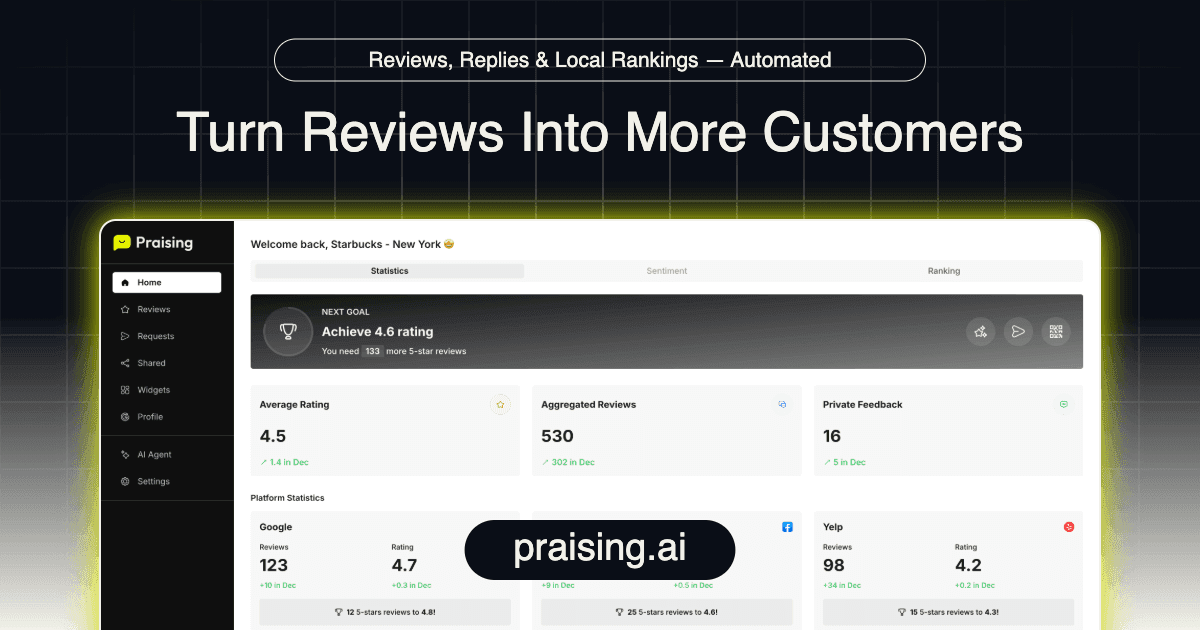
Manually chasing testimonials doesn't scale. Praising.ai automates review requests to Google and the other review sites you connect, so your agency builds a steady stream of fresh testimonials without anyone on your team sending individual emails.
Where to Display Them
- Website homepage — your three strongest quotes with client logos
- Service pages — testimonials relevant to that specific service
- Proposals and pitch decks — industry-matched case studies
- Social media — regular posts featuring client wins
- Email signatures — a rotating client quote with a link to more
Frequently Asked Questions
How often should an agency collect new testimonials?
After every major milestone or quarterly review. Fresh testimonials signal that your agency is actively delivering results, not coasting on wins from years ago. Aim for at least one new testimonial per month.
What if a client doesn't want to give a public testimonial?
Offer alternatives: an anonymous quote with industry and company size, a private reference they'll take calls for, or a written case study they can approve before publication. Some clients have legal restrictions on endorsements — respect that and work within their constraints.
Should agencies pay for testimonials?
No. Paid testimonials damage trust if discovered and may violate platform policies. Instead, make the process easy and ask at the right moment. Most satisfied clients are happy to help — they just need a prompt.
Ready to grow?
Turn happy customers into 5-star reviews
Praising.ai automates review requests for Google, Trustpilot and the other review sites you use. Businesses see an average 3x increase in reviews within 30 days.
Written by
· 106 articlesMarcus Webb
Reputation Management Specialist
Marcus has spent over a decade helping small and medium businesses understand online reviews and local search. He writes about Google Business Profile, review automation, and the mechanics of reputation management—always from the angle of what actually moves the needle for independent businesses.
View all articlesGet weekly review tips
Actionable strategies to grow reviews and revenue, straight to your inbox.
No spam. Unsubscribe anytime.
Get more 5-star reviews on autopilot
Praising.ai automates review requests for Google, Trustpilot and the other review sites you use — free to start, no credit card required.
Start FreeFree 14-day trial