AI Hotel Rating Improvement: 5 Strategies That Work in 2026

TL;DR
AI improves hotel ratings through three compounding mechanisms: automated post-checkout review requests that 3-5x review volume, AI-drafted responses that push response rates to 100%, and sentiment analysis that catches operational problems before they become rating patterns. Most properties see measurable improvement on major OTA platforms within 60-90 days.
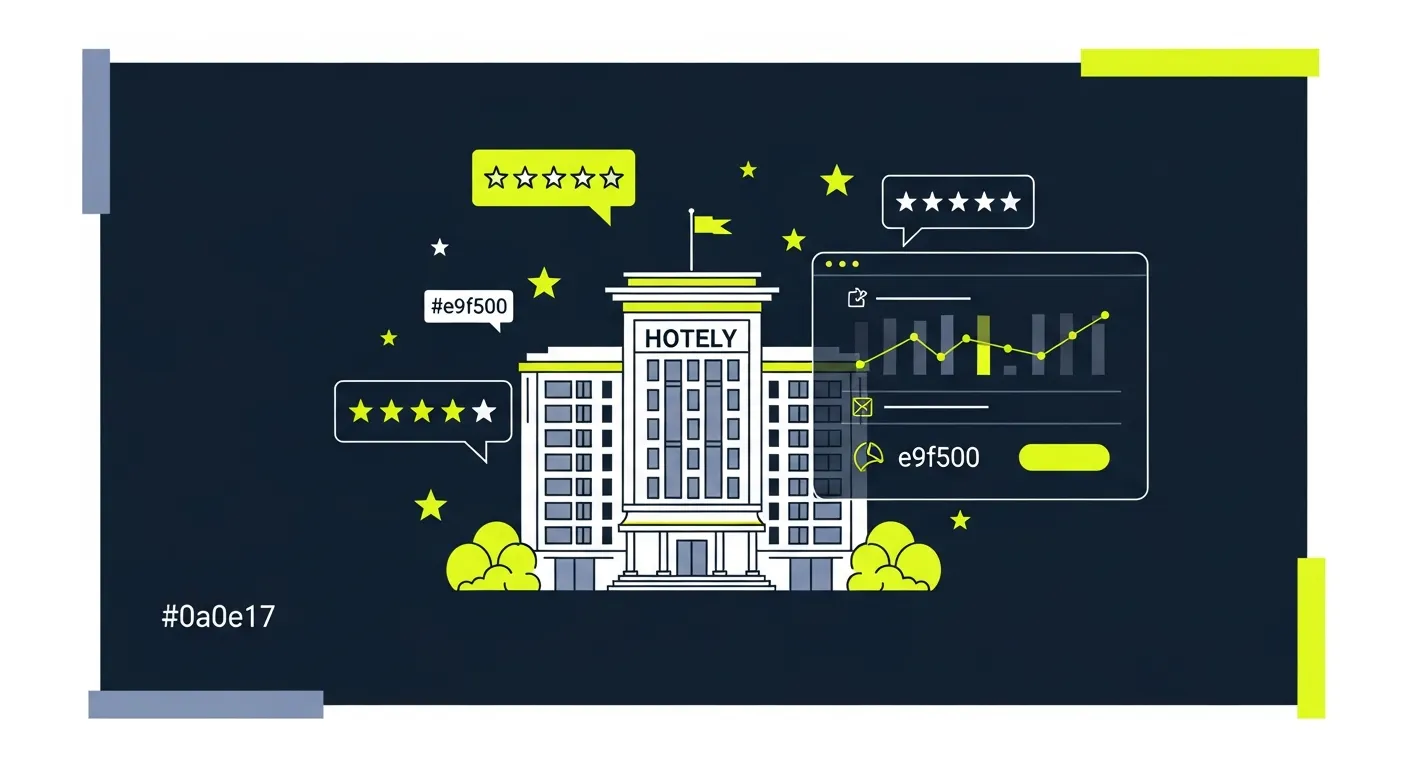
Hotels live and die by their online ratings. A 0.3-point improvement in your Google or TripAdvisor score can translate directly into higher occupancy, better ADR, and stronger OTA rankings. The challenge: getting there manually is slow, inconsistent, and impossible to scale. That is exactly where AI hotel rating improvement tools change the equation.
This guide explains how AI works to improve hotel ratings, which strategies produce the fastest results, and how to implement them without overhauling your existing operations.
Results Hotels See With AI Rating Improvement
Before choosing strategies, it helps to know what the data shows for hotels that have already implemented AI-assisted reputation management:
| Metric | Manual Approach | With AI Assistance |
|---|---|---|
| Review request send rate | 10–20% of checkouts | 95–100% of checkouts |
| Post-checkout review conversion | 2–5% | 8–18% |
| Review response rate | 40–60% (staff-limited) | 95–100% |
| Average response time | 2–5 days | Under 4 hours |
| Sentiment issue detection | Weeks or never | Same-day alert |
These numbers reflect the compounding effect: higher send rates produce more reviews, more reviews push OTA ranking, faster responses improve booking conversion, and sentiment alerts stop operational problems before they damage your average. None of these gains requires hiring additional staff — they come from applying AI to work that was previously too time-consuming to do consistently.
Cornell's Center for Hospitality Research found that a one-point improvement in a hotel's online reputation score correlates with up to an 11.2% increase in ADR without sacrificing occupancy. That makes AI hotel rating improvement a revenue-management decision, not just a marketing one.
Why AI Changes Hotel Rating Improvement
Traditional hotel rating improvement meant hiring someone to send follow-up emails, read reviews, write responses, and flag complaints for management — work that is valuable but difficult to do consistently across every guest, every shift, every platform.
AI automates the consistent parts — the asking, the monitoring, the drafting — so your team can focus on the irreplaceable human element: resolving genuine complaints and delivering memorable guest experiences.
The impact compounds. A hotel that sends a review request to every checkout guest, responds to every review within 24 hours, and uses sentiment data to catch operational issues early will outperform a competitor doing none of these things by a measurable margin within 90 days. AI makes that consistency achievable without proportionally increasing headcount.
Five AI Strategies for Hotel Rating Improvement
- Automated Post-Checkout Review Requests
The single highest-leverage action in hotel rating improvement is asking more guests to leave reviews. Most hotels rely on passive hope — guests who had a good experience remembering to post about it on their own. They forget. AI-powered review collection changes the default.
When a guest checks out, an automated system sends a personalized review request via email or SMS within 24 to 48 hours — the window when the stay is freshest and guests are most receptive. The message references their stay details (arrival date, room type, or location when available) rather than sending a generic template that feels mass-produced.
What this does for your rating: Hotels that implement consistent automated review requests typically see 3x to 5x more review volume within 60 days. More reviews from genuinely satisfied guests raises your overall average, and higher review velocity improves your OTA algorithm ranking on Booking.com, Expedia, and TripAdvisor simultaneously.
A private feedback option adds to the effect. Guests who would rather raise a problem directly can send it privately from the same page as the review link, which captures actionable operational feedback.
- AI-Drafted Responses That Build Trust
Response rate is a direct ranking signal on major hotel platforms. Booking.com, TripAdvisor, and Google all factor in how consistently and quickly you respond when determining where your property appears in search results.
AI hotel rating improvement tools generate responses to every review — positive, negative, and mixed — within minutes of the review posting. Each response references specific details from the guest's text rather than recycling a generic template. A complaint about room temperature gets a calm, professional acknowledgment and an explanation of corrective action. A glowing review about the breakfast gets a warm thank-you that invites the guest to return.
Why this matters: Travelers reading reviews are as influenced by hotel responses as they are by the reviews themselves. A well-written response to a one-star complaint signals that management cares and the issue is unlikely to recur. Hotels with consistently high response rates see higher booking conversion rates from review-reading travelers — and the OTA algorithms reward that consistency with better placement.
You review and approve every AI-drafted response before it goes live. The AI handles the time-consuming first draft; your team adds the human touch in 30 seconds instead of 10 minutes.
- Sentiment Analysis for Operational Improvements
One of the most powerful — and least-used — applications of AI in hotel rating improvement is using review data to identify operational problems before they become systemic.
AI sentiment analysis reads across every review on every platform and extracts the themes guests keep mentioning: noise, cleanliness, Wi-Fi speed, breakfast quality, check-in wait times, parking. When a theme spikes — say, mentions of noise increasing from 5% of reviews last month to 18% this month — the system surfaces it immediately.
The rating improvement mechanism: Most rating problems are rooted in recurring operational failures that management doesn't know are patterns. A noisy HVAC unit, a breakfast that has quietly gotten worse, a new front desk procedure guests find confusing — these issues generate a steady trickle of 2- and 3-star reviews that drag your average down month after month. AI catches them early, when the fix is still simple and cheap.
Properties using sentiment analysis for hotel rating improvement treat their review data as a live quality-management system rather than a PR problem to react to. The proactive approach stops the rating erosion before it starts.
- Competitive Benchmarking with AI
Improving your hotel rating is partly absolute (get your score higher) and partly relative (outperform the competition in your market). AI-powered competitive intelligence aggregates review data from comparable properties — same category, same location, same price tier — and surfaces where you are outperforming or underperforming them.
If your closest competitor has a 4.6 TripAdvisor score and yours is 4.2, the gap is the target. AI tools can show you which review categories (rooms, service, location, value) are driving the difference. If their guests consistently rate "service" as a 9.2 and yours rate it a 7.4, that is where to focus your hotel rating improvement effort, not on your already-strong "location" score.
The strategic benefit: Benchmarking stops you from optimizing the wrong things. Hotels often over-invest in areas guests already rate highly and under-invest in the gaps that are actually costing them bookings.
- Predictive Rating Management
Advanced AI hotel rating improvement systems go beyond reacting to reviews — they predict rating trajectories based on review velocity, sentiment trends, and seasonal patterns.
If your current review velocity and average sentiment suggest your rating will drop 0.2 points over the next 60 days (because your seasonal volume is declining faster than your positive-to-negative ratio), the system flags it now. You can accelerate your review collection efforts proactively rather than scrambling to recover after the rating has already fallen.
This is particularly valuable for hotels managing OTA rankings, where even a 0.1-point change in score can shift your Booking.com placement by several positions in a competitive urban market.
How to Implement AI Hotel Rating Improvement
Step 1: Connect Your Review Platforms
Any AI hotel rating improvement tool needs visibility across all platforms where guests leave reviews. At minimum, connect Google Business Profile, TripAdvisor (via management center API), and Booking.com. Most hospitality AI platforms also support Airbnb, Expedia, Hotels.com, and Agoda.
Once connected, the AI has a baseline — your current rating, review volume, response rate, and sentiment breakdown — to improve against.
Step 2: Set Up Automated Review Collection
Configure your post-checkout review request sequence. The key decisions: timing (24-48 hours after checkout), channel (email, SMS, or both), platform routing (Google for business travelers, TripAdvisor for leisure guests), and a private feedback option next to the public review link.
Most hotel teams test two or three message templates before settling on the version that converts best for their guest mix. AI tools often include A/B testing built in.
Step 3: Review and Approve AI Responses in Batch
Build a daily or twice-daily routine of reviewing AI-drafted responses. For most properties, 10 to 20 minutes per day handles the full review backlog — the AI has done the writing, you are editing and approving. Keep response times under 24 hours for negative reviews, under 72 hours for positives.
Step 4: Act on Sentiment Alerts
Set thresholds for operational alerts: if any theme appears in more than 10% of reviews in a 7-day window, surface it to the department head responsible. Noise complaints go to maintenance, breakfast complaints go to F&B, check-in wait times go to front office management. Close the loop in your next operations meeting with data from the review system.
Step 5: Track Rating Trends Monthly
Review your overall score, platform-by-platform, each month. Compare review volume, response rate, and sentiment category breakdowns against your previous month and against the same period last year. Identify whether your improvement efforts are working and where to double down.
How Praising.ai Accelerates Hotel Rating Improvement
Praising.ai is built for hospitality businesses that need a systematic approach to hotel rating improvement without adding headcount. The platform handles review collection, cross-platform monitoring, AI-powered response drafting, and sentiment analytics in one connected system.
Key features for hotels:
- Automated post-checkout review requests via email and SMS, with smart platform routing and a private feedback option next to the public review link
- AI-drafted responses for every Google and Trustpilot review — personalized to the specific feedback, reviewed and approved in seconds
- Sentiment analysis dashboard surfacing operational themes across all review text
- Multi-property roll-up for hotel groups managing multiple locations from a single account
- Rating trend tracking with month-over-month and year-over-year comparison
The hotels industry page goes deeper on hospitality-specific features. See pricing for plan details, or read the general hotel review management guide for a broader overview of managing hospitality reviews.
Frequently Asked Questions
How quickly does AI hotel rating improvement produce results?
Most properties see measurable rating improvement within 60 to 90 days of implementing consistent automated review collection and AI-powered response management. Review volume typically increases 3x to 5x within the first 60 days, which is the fastest driver of OTA ranking improvement. Rating average improvement is slower — it depends on the current ratio of positive to negative reviews — but steady progress is visible month over month.
Does AI write review responses automatically, or does a human still review?
The AI drafts the response; a human reviews and approves before it goes live. This is the standard model for AI hotel rating improvement tools and maintains full control over what appears publicly under your hotel's name. The AI handles the time-consuming first draft — referencing specific details from the review, matching your property's tone — and your team approves in seconds. Fully automated posting without human review is possible but not recommended for hotel brands where voice consistency matters.
Which review platforms matter most for hotel rating improvement?
Google is the highest priority for local search visibility and direct booking influence. TripAdvisor is essential for leisure travelers researching destinations. Booking.com and Expedia matter because their internal ranking algorithms directly influence booking volume from those OTAs — and their guest-verified review systems carry high credibility. Improving across all three simultaneously has a multiplying effect on overall property reputation.
Can AI help hotels identify operational problems causing low ratings?
Yes. Sentiment analysis is one of the most practical applications of AI in hotel rating improvement. When AI processes hundreds or thousands of reviews and identifies that noise complaints have doubled month-over-month, or that breakfast mentions in negative reviews spiked after a menu change, it surfaces operational insights that would take hours to identify manually. Hotels that act on sentiment data typically fix the root problems faster and see rating improvement that is durable rather than cosmetic.
Ready to grow?
Turn happy customers into 5-star reviews
Praising.ai automates review requests for Google, Trustpilot and the other review sites you use. Businesses see an average 3x increase in reviews within 30 days.
Written by
· 106 articlesMarcus Webb
Reputation Management Specialist
Marcus has spent over a decade helping small and medium businesses understand online reviews and local search. He writes about Google Business Profile, review automation, and the mechanics of reputation management—always from the angle of what actually moves the needle for independent businesses.
View all articlesGet weekly review tips
Actionable strategies to grow reviews and revenue, straight to your inbox.
No spam. Unsubscribe anytime.
Get more 5-star reviews on autopilot
Praising.ai automates review requests for Google, Trustpilot and the other review sites you use — free to start, no credit card required.
Start FreeFree 14-day trial